
Module 5 · 5.2
What happens when a domain expires
Module 5: Renewing, expiring and cancelling · Reading time: 10 minutes
Learning objective: After this lesson you can explain, per extension, which phases a domain goes through after it expires or is cancelled, how long those phases last and until when you can still get the name back.
Key concepts: expiry date, auto-renew grace period, redemption grace period, pending delete, cancellation, quarantine, .de redemption, website and mail stopping, restoration
Expired does not mean gone straight away
A domain that is not renewed, or that you cancel, is not immediately available to everyone. The registries in this lesson all have a period in which only the previous registrant can still get the name back. It is a safety net for mistakes: a failed payment, a forgotten renewal, cancelling the wrong domain.
But that safety net differs per extension, and it comes at a price: in almost all cases your website and your email already stop working during that period. If you think "I still have weeks", remember that during those weeks customers cannot open your site and email sent to you bounces or disappears.
The periods in this lesson reflect the situation as of November 2026. Registries sometimes change their rules; if in doubt, check the registry's website.
.com and other gTLD's: three phases
For .com and many other gTLD's, the path after the expiry date usually looks like this:
- Auto-renew grace period. After the expiry date there is first a period of up to 45 days in which the name is still with your registrar. During that time you can usually still renew as normal. Important: the registrar may also delete the name earlier. How long you can still renew therefore depends on your registrar.
- Redemption grace period. Once the registrar has deleted the name at the registry, there are 30 days in which the name can still be restored. You request this through your registrar. In RDAP you will then see the status redemptionPeriod (lesson 4.3).
- Pending delete. If the name has not been restored after the redemption period, it is set to pendingDelete for 5 days. Restoring is no longer possible at that point. After that, the name is available to everyone.
Under ICANN's rules, the registrar must at some point after the expiry date interrupt your website and email, at least during the last eight days in which you can still renew. If you renew after all, the registrar must quickly switch everything back on.
So for .com, never count on 80 days. The first phase can be much shorter than 45 days, and from the moment the registrar deletes the name, the clock of 30 plus 5 days starts ticking.
.nl: cancellation and 40 days of quarantine
The Dutch extension .nl works differently. There is no separate phase after the expiry date: your registrar cancels the name at SIDN, for example because you cancelled it or did not pay. At that moment the name goes into quarantine for 40 days.
- In the .nl Whois you will see the status "In quarantine" and the date on which the name becomes available.
- During those 40 days, only the previous registrant can get the name back. This can be done through the old registrar, but also through a new registrar.
- After the 40 days, SIDN releases the name at a random moment within one hour after the stated time. From then on, anyone can register it.
SIDN does not know why a name was cancelled. If your .nl name is unexpectedly in quarantine, ask your registrar what happened.
.de: 30 days of redemption
When a .de name is deleted, DENIC applies a Redemption Grace Period of 30 days. During that time only the last registrant (or someone they designate) can re-register the name, through the old or a new provider. After that, anyone can register it.
There is one special situation. If the provider of a .de name stops, DENIC temporarily takes over management and the registrant receives a letter. If the registrant does nothing, the name is deleted, and the 30 days still follow after that. So always respond to post from DENIC.
.eu and .be: 40 days of quarantine
With .eu and .be a deleted name also goes into quarantine, for 40 days in both cases.
- .eu: during the quarantine, website and email do not work. The registrant can have the name reactivated through their registrar or a new registrar. After that, it is available to everyone. Note the difference with a suspended .eu name: that one has the status "Server Hold", for example because the registrant has not confirmed their details. That is not quarantine: you solve it by getting your details in order.
- .be: during the quarantine the name cannot be reached and email does not work. You can get it back through the old registrar (reactivation) or with a transfer out of quarantine to another registrar.
Overview
| Extension | After expiry or deletion | Getting it back | After that |
|---|---|---|---|
| .com and many gTLD's | Up to 45 days of grace at the registrar, then 30 days of redemption, then 5 days of pending delete | Renew during the grace period, restore during redemption | Available to everyone |
| .nl | 40 days of quarantine | Previous registrant only, through old or new registrar | Available within one hour after the release time |
| .de | 30 days of redemption | Last registrant only, through old or new provider | Available to everyone |
| .eu | 40 days of quarantine | Registrant through a registrar | Available to everyone |
| .be | 40 days of quarantine | Reactivation or transfer out of quarantine | Available to everyone |
Two things apply everywhere. First: restoration usually goes through a registrar, not directly through the registry. Second: during all these periods your website and your email are usually already down. Renewing on time is therefore always better than getting a name back (lesson 5.1).
In practice: how it works at WebOké
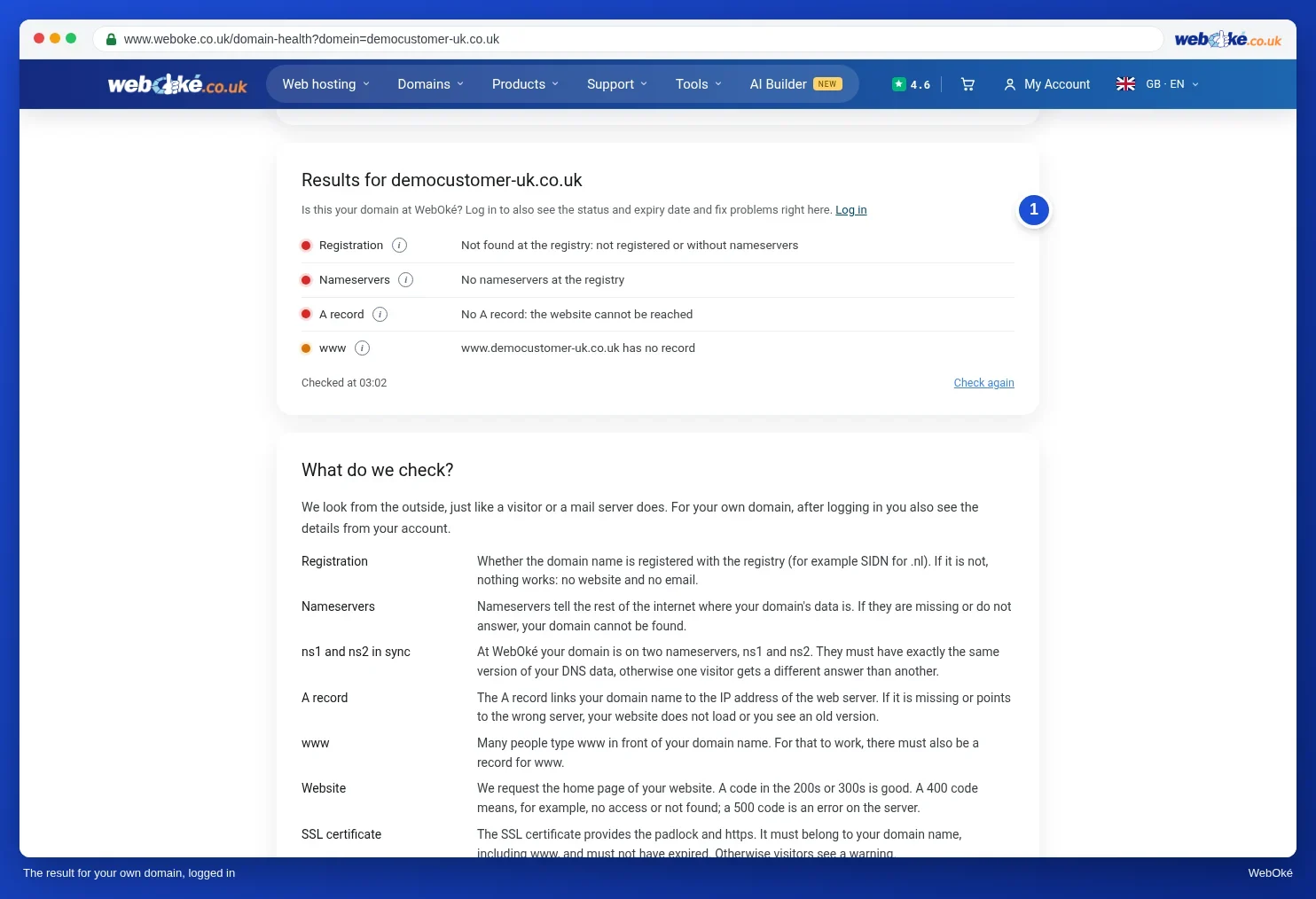
If you cancel a domain at WebOké, it stays active until the end date. If you choose immediate deletion for a .nl domain, the name goes straight into the 40 days of quarantine in which only you can have it brought back. On the Domain health page you will see lines about the status, the expiry date and any quarantine for your own domain. Other registrars work in a similar way, but how long a registrar keeps an expired gTLD name varies.
Summary
- An expired or cancelled domain is not immediately available: first there is a period in which only the previous registrant can get it back.
- For .com: up to 45 days of grace (the registrar may make it shorter), then 30 days of redemption and 5 days of pending delete.
- For .nl, .eu and .be: 40 days of quarantine; for .de: 30 days of redemption.
- During these periods, website and email usually no longer work.
- Getting a name back usually goes through your old or a new registrar, not through the registry itself.
Quiz
Exercise
Exercise A5.2: Which phase? (case study). Below are five domains. For each domain, choose which phase it is in today. Use the periods from this lesson.
- A .com name expired 20 days ago. The registrar has not yet deleted it at the registry.
- A .nl name was cancelled at SIDN by the registrar 25 days ago.
- A .de name was deleted at DENIC 12 days ago.
- A .com name: the registrar deleted the domain at the registry 32 days ago and nobody has restored it.
- A .be name was cancelled 45 days ago and deleted at DNS Belgium on the same day. Nobody has brought it back.
For each domain, choose from:
- active
- expired but can still be renewed as normal
- redemption period (redemption)
- quarantine
- being permanently deleted (pending delete)
- available to everyone
The program compares your answers with a fixed key. If you make a mistake, you get a hint and can try again.
Further reading
- Recovering an expired or cancelled domain: quarantine and redemption period
- Cancelling products and domains, withdrawing a cancellation, and what happens next
- Undoing the cancellation of a domain name (SIDN): https://www.sidn.nl/en/nl-domain-name/undoing-the-cancellation-of-a-domain-name
- Redemption Grace Period (DENIC): https://www.denic.de/en/products/de-domains/deletion/redemption-grace-period/
- Domain name renewal and expiration FAQs (ICANN): https://www.icann.org/resources/pages/domain-name-renewal-expiration-faqs-2018-12-07-en